
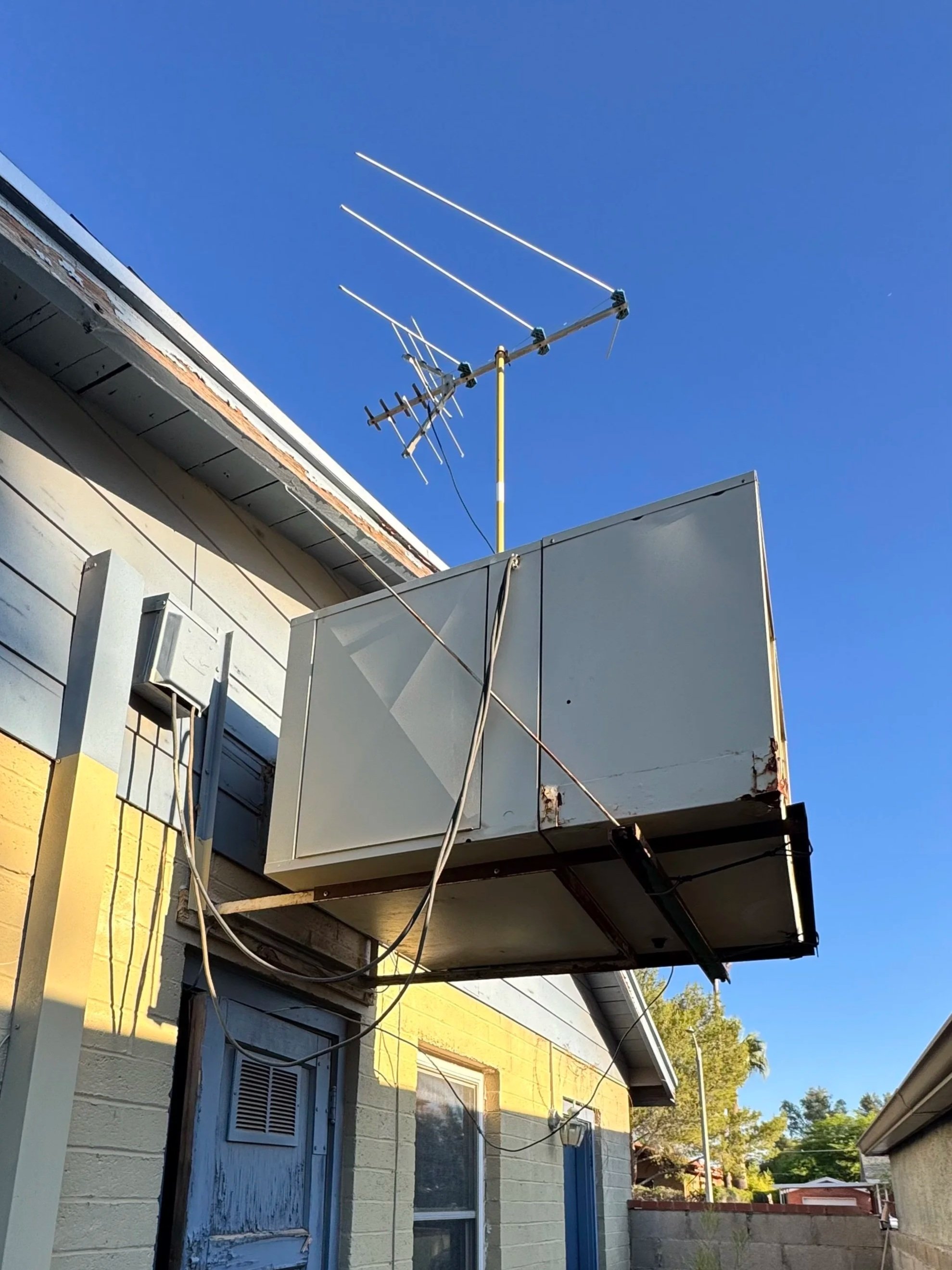
What is a swamp cooler, and do Tucson homes need air conditioning? A swamp cooler, also called an evaporative cooler, cools a home by pulling dry outside air through water-soaked pads, and it works best during Tucson’s hot, dry months. Refrigerated air conditioning works in any humidity, including during the summer monsoon. Swamp coolers were once standard on Tucson homes, but today most homes rely on refrigerated air, and coolers are found mainly on older properties.
That Box on the Roof
Drive through an older Tucson neighborhood and you will notice metal boxes perched on many rooftops. For newcomers, they are often the first real clue that desert homes work a little differently.
Those boxes are evaporative coolers, better known around here as swamp coolers. They have been part of Tucson living for generations, and understanding them is one of the easiest ways to make sense of the cooling details you will see in local listings.
How a Swamp Cooler Works
A swamp cooler runs on a simple principle: evaporation cools the air.
A fan pulls outside air through pads kept wet by a small water pump. As the water evaporates, the air passing through the pads drops in temperature, and that cooler air is pushed into the home. Unlike refrigerated air conditioning, a swamp cooler adds some moisture to the air rather than removing it, which many people appreciate in a climate this dry.
Because the cooler is constantly bringing in fresh outside air, most homes with one keep a window or vent slightly open so the air has somewhere to go.
Pro Tip: “Evaporative cooling” and “swamp cooler” in a listing mean the same thing.
How Refrigerated Air Conditioning Differs
Refrigerated air conditioning, which most people simply call AC, uses a compressor and refrigerant to cool and dehumidify air inside a closed home. It works the same way whether the outside air is dry or humid.
That consistency is a big reason air conditioning has become the standard in Tucson homes. When you see “refrigerated air” in a listing, it is referring to this type of system.
Why the Monsoon Changes Everything
Tucson has two very different kinds of summer heat. Late spring and early summer bring dry heat, which is when swamp coolers do their best work.
When the monsoon arrives and humidity rises, evaporation slows down and a swamp cooler becomes noticeably less effective. That limitation is a big part of why so many Tucson homeowners have moved to refrigerated air over the years. If you are new to the Southwest, our post on Tucson’s monsoon season explains what those summer months feel like.
Older Homes and Rooftop Coolers
Many Tucson homes that once relied on a swamp cooler have since converted to refrigerated air. In older neighborhoods, you may still see a cooler on the roof of a home that now uses AC, and some homeowners have removed theirs entirely.
Homes that still use a swamp cooler as their main source of cooling are less common today, but they remain part of the city’s housing story, especially in midcentury and older neighborhoods.
Pro Tip: If a home has a rooftop cooler, ask whether it is still in use.
Water and Electricity
The two systems use resources differently. Swamp coolers generally use considerably less electricity than refrigerated air, according to University of Arizona Cooperative Extension. They do use water, and that water use is part of the trade-off in a desert city where conservation matters.
Air conditioning uses more electricity but no water at the unit itself. How either system performs in a particular home depends on its size, age, condition, and the home’s design.
Seasonal Care in the Desert
Fall is when Tucson homeowners with swamp coolers shut them down for the winter. That usually involves turning off and draining the water supply and covering or closing off the cooler so warm air does not escape through it during cooler months. In spring, the process reverses, and pads are replaced as they wear out.
Air conditioning systems in Tucson typically get routine servicing before the long cooling season. For both, a licensed HVAC professional is the right resource for specific maintenance questions.
Pro Tip: If you are touring homes this fall or winter, a covered rooftop box is likely a swamp cooler that has been shut down for the season.
What This Means When You Are Looking at Homes
Cooling is one of the features that feels different here than in other parts of the country. In a Tucson listing, you will most often see refrigerated air, and in some older homes, evaporative cooling. Each says something about how the home was built and how it has been updated over time.
If you are researching a move to Tucson, understanding these terms makes it easier to compare homes and ask good questions during a home inspection. Kristen is always happy to walk buyers through what they are seeing, from rooftop coolers to courtyards and everything in between.
Frequently Asked Questions
Why is it called a swamp cooler?
“Swamp cooler” is the common nickname for an evaporative cooler. The name is widely used across the Southwest, and many people believe it comes from the musty smell older or poorly maintained units can produce.
Do swamp coolers work in Tucson?
Yes. Swamp coolers work well during Tucson’s hot, dry months. They become less effective during the summer monsoon, when humidity is higher.
Do newer Tucson homes have swamp coolers?
Most newer homes in Tucson are built with refrigerated air conditioning. Swamp coolers are found mainly on older homes.
Are swamp coolers still common in Tucson?
They are less common than they once were. Many older homes have converted to refrigerated air, though you will still see rooftop coolers in established neighborhoods.
What happens to a swamp cooler in the winter?
Most homeowners shut their swamp coolers down in the fall by turning off and draining the water and covering or closing off the unit until spring.
Presented by Kristen Glasheen, REALTOR®, Glasheen Real Estate, Long Realty Company.
☎️ Call: 520.345.9360
📱 Text: 520.345.9360
📧 Email: Kristen@GlasheenRealEstate.com
🏠 Search Homes
Disclaimer: Glasheen Real Estate is not an HVAC contractor or home inspector. Cooling system performance, condition, and maintenance needs vary by home. Please consult a licensed HVAC professional or home inspector with specific questions. This content is for informational purposes only.