
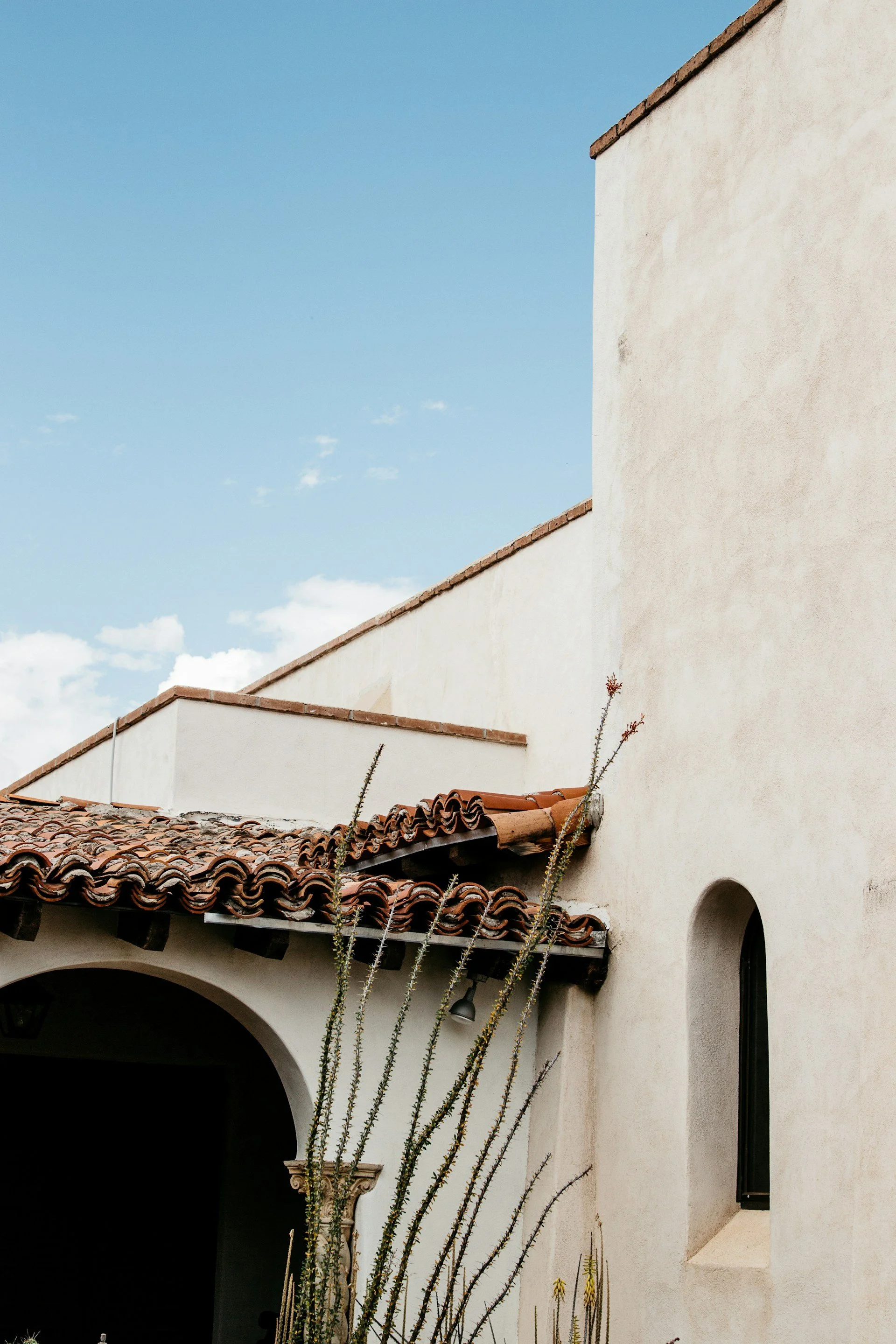
Photo by Bree Evans on Unsplash
What are the common home styles in Tucson? Tucson’s architecture reflects the region’s history and desert climate, from Sonoran adobe row houses with thick walls and flat roofs to Spanish Colonial Revival homes with clay tile roofs and courtyards, Pueblo Revival, and post-war Ranch styles. Many features, like parapets, shaded patios, and thick masonry walls, grew out of life in the Sonoran Desert. Knowing the vocabulary makes browsing Tucson listings much easier.
Why Tucson Homes Look the Way They Do
Walk down a street in Barrio Viejo and nearly every house sits right at the edge of the sidewalk, with a brightly painted door facing the street. Drive up into the Catalina Foothills, and you will see clay tile roofs, courtyards, and arched entryways instead.
Both are Tucson. If you are new to the area, the styles can feel unfamiliar, and listings are full of terms you may not have heard. Here is a plain-language guide.
Sonoran Row Houses: Tucson’s Original Style
The City of Tucson describes the Sonoran style as part of the Spanish-Mexican building tradition of the region. These are thick-walled adobe buildings set on the street property line, with flat roofs and high parapet walls.
Look for a few signature details:
Vigas: round wooden roof beams
Saguaro-rib roof decks: ribs from saguaro cactus used as part of the roof structure
Canales: drainpipes that project through the parapet wall to carry rain off the roof
A zaguan: a central hall running through the house, found in some floor plans
Later “Transformed Sonoran” houses are similar but add features like pyramidal or gabled metal roofs and brick caps on the parapets, changes that followed the railroad’s arrival and the new building materials it brought.
You will see Sonoran row houses in Barrio Viejo, El Presidio, and Barrio Santa Rosa near downtown.
Revival Styles of the 1920s and 1930s
By the 1920s, Tucson developers began promoting regional revival styles, including Spanish Colonial, Mission, and Pueblo, to connect with the imagery of the Southwest. Many neighborhoods built in that era still show the influence.
Spanish Colonial Revival
This is probably the style most people picture when they think of Tucson. The Society of Architectural Historians describes the Catalina Foothills Estates houses as variations of Spanish Colonial Revival, with details like arches, breezeways, brick and stucco, clay tile roofs, courtyards, and wrought-iron ornamentation.
Much of that look traces back to architect Josias Joesler, who moved to Tucson in 1927 and designed more than 400 buildings. His Foothills homes often feature enclosed patios and porches and were sited to preserve as much natural terrain as possible.
Pueblo Revival
Pueblo Revival homes, popular in Tucson roughly from 1920 to 1950, draw on the building forms of the Southwest. Look for earth-colored stucco walls, simple window openings, and flat roofs with rounded or stepped parapets, often with round roof beams (vigas) projecting through the walls. A helpful first clue is the roofline: red clay tile often points to Spanish Colonial Revival, while a flat roofline with rounded parapets often points to Pueblo Revival. Many Tucson homes blend elements of both, which is part of what gives local architecture its distinct character.
Ranch and Mid-Century Homes
After World War II, the Ranch house became a common sight in Tucson, as it did across the country. These homes are typically set back from the street, with large picture windows and sliding glass doors that open to outdoor living areas. Tucson also has regional variations. Post-war Territorial homes, sometimes called Territorial Ranch, keep the Ranch layout but add flat roofs, parapets, a more articulated front facade, and tiled shed roofs over the entry. Spanish Colonial Ranch homes blend the Ranch layout with Spanish-influenced details. Mid-century modern homes also appear in many neighborhoods, alongside Craftsman bungalows and other period styles.
You may also see the term “burnt adobe” in listings. It refers to fired adobe block made in northern Mexico, which is different from the sun-dried mud adobe used in historic Sonoran buildings. It was widely used in Tucson homes built after World War II.
Features You Will See Across Styles
Even when styles differ, a few ideas repeat throughout Tucson:
thick masonry or adobe walls
courtyards and enclosed patios
covered porches and shaded outdoor spaces
flat roofs with parapets and canales, or clay tile roofs
desert landscaping that works with the setting
These are practical responses to strong sun and occasional heavy rain, and they are a big part of why Tucson homes feel so connected to their surroundings.
Where to See These Styles in Person
You can see Sonoran row houses by walking Barrio Viejo, where guided walking tours explore the neighborhood’s adobe architecture. St. Philip’s in the Hills, completed in 1936 and designed by Josias Joesler, is a well-known example of Spanish Colonial Revival in the Foothills.
Pro Tip: Use style names in your home search. Terms like “Spanish Colonial Revival” or “Sonoran” can narrow listings faster than a general description.
Finding the Style That Fits You
If you are researching Tucson from out of town, style is a great way to start. Many people discover they are drawn to courtyard homes, flat-roofed adobe, or mid-century lines before they ever decide on a neighborhood. Kristen can help you search with those preferences in mind.
Frequently Asked Questions
What is a Sonoran row house?
It is a style of thick-walled adobe building set at the street property line, with a flat roof and parapet walls. It is part of Tucson’s oldest architectural tradition.
What are vigas and canales?
Vigas are round wooden roof beams. Canales are drainpipes that project through a parapet wall to carry rainwater off the roof.
What is Spanish Colonial Revival?
It is a style known for clay tile roofs, courtyards, arches, and wrought-iron details. It is common in Tucson, especially in the ƒ.
What is the difference between adobe and stucco?
Adobe refers to sun-dried mud brick construction. Stucco is a plaster finish, and some Tucson homes are adobe with a stucco or plaster coating.
Where can I see historic Tucson architecture?
Barrio Viejo and El Presidio near downtown are good places to start, and local organizations offer guided tours.
Presented by Kristen Glasheen, REALTOR®, Glasheen Real Estate, Long Realty Company.
Contact Kristen:
☎️ Call: 520.345.9360
📱 Text: 520.345.9360
📧 Email: Kristen@GlasheenRealEstate.com
DISCLAIMER: Glasheen Real Estate is not an architect, builder, or historian. Style descriptions are general, and individual homes vary. This content is for informational purposes only.